

The City – Pombal
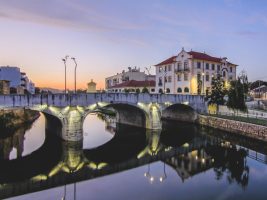
Seat of a mostly rural municipality, full of history and wide natural landscapes that stretch from the sea to the mountains, Pombal rises as the urban centre of the county, about 150 km from the cities of Lisbon and Porto and approximately 30 km from Coimbra and Leiria.
The intimate and serene atmosphere of the city serves every year, at the end of October, as a cinematic retreat for filmmakers and lovers of comedy cinema, who gather there to watch, think and talk about films.
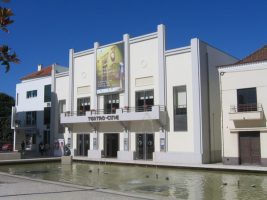
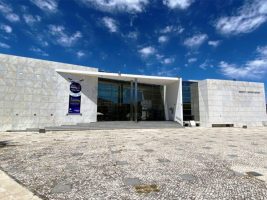
In its many activities, HaHaArt expands through several venues, all of them cultural and representative spaces of Pombal, namely the Teatro‑Cine de Pombal, the Municipal Auditorium, and Casa Varela.
HOW TO GET HERE
Its privileged geography makes Pombal easily accessible by public transport and a mandatory stop for anyone travelling along N1 and A1, the main roads in the country. In addition, for those coming from abroad, the internacional airports Humberto Delgado (Lisbon) and Francisco Sá Carneiro (Porto) have easy connection to the city.
Car:
The A1 motorway, as well as the IC2 and IC8, are the best and fastest options to reach the city of Pombal.
Bus:
For those coming from Leiria, the district capital, we recommend the interurban bus of Rodoviária do Lis (RDL).
You can check the schedules here:
[LINK]
Train:
With the Railway Station located in the city centre and served by the main Portuguese railway line, Pombal is accessible via regional trains, Intercity, Alfa Pendular, and international trains. Trips to Pombal departing from Lisbon and Porto have an approximate duration of 1h30 when traveling on the intercity trains.
For more information on CP prices and schedules: [LINK]
WHERE TO STAY

Belém Hotel – B&B
Av. Heróis do Ultramar 185, 3100-462 | Tel.: +351 236 200 800 | Learn more
EXPLORE POMBAL
TEATRO-CINE OF POMBAL
Built in the 1940s, the Teatro‑Cine de Pombal was born from the desire of a group of citizens to create a new space dedicated to performance, after the destruction of the theatre that existed in the city. The projects, signed by architects Camilo and Ernesto Korrodi, gave rise to a building with a sober Art Déco language, which became part of the city’s cultural memory. Closed for several years, the space was restored and reopened in 2002. Today, the Teatro‑Cine is the heart of the HaHaArt Film Festival and the main meeting point between the festival and the public.
CASA VARELA – CENTRE FOR ARTISTIC EXPERIMENTATION
Built in 1924 from a project by architect Ernesto Korrodi, Casa Varela is a living element of Portuguese architecture. A commercial space for decades, the former Armazém Varela was refurbished by the Municipality and opened its doors in 2021 as a Centre for Artistic Experimentation, dedicated to contemporary creation and to the encounter between artists, community, and territory.
CASTLE OF POMBAL
Built in the 12th century on a strategic defensive position over the Mondego line and the city of Coimbra, Pombal Castle was fundamental in the defence of the territory during the Reconquest and in the development of the medieval town. Between the walls, the keep, and the views over the city, it is today one of the most emblematic places in Pombal.
MARQUIS OF POMBAL SQUARE
The Marquis of Pombal Square (Praça Marquês de Pombal) brings together some of the most important testimonies of the Marquis’ presence in the city, including the former Granary (Celeiro), now the Portuguese Folk Art Museum, and the former Old Jail, now the Marquis of Pombal Museum. The ensemble preserves elements of Pombaline architecture, including the characteristic gaiola (cage) construction, developed after the 1755 earthquake.
MOTHER CHURCH OF SAINT MARTIN
Located in Praça Marquês de Pombal, and with documented existence since the 13th century, the Mother Church of Saint Martin (Igreja Matriz de São Martinho) spans centuries of history. In 1323, it was the stage for the public oath of peace between King Dinis and his son, King Afonso IV, mediated by Queen Saint Isabel. Rebuilt in 1520, it was later looted and devastated by French troops before being reconstructed in the 19th century. With a modest Romanesque exterior, it preserves inside memories from different periods, from the Renaissance stonework of the Chapel of Our Lady of Piety to the Baroque gilded woodcarving and the tile panel that evokes the 1323 historic oath.
MARQUIS OF POMBAL MUSEUM
Housed in the former Old Jail commissioned by the Marquis of Pombal in 1776, the Marquis of Pombal Museum (Museu Marquês de Pombal) occupies one of the most emblematic buildings in the square that pays tribute to man. Inside, a collection of objects, documents, and artworks follows the life of Sebastião José de Carvalho e Melo and the time in which he lived, revealing different dimensions of the Marquis’ figure and his connection to Pombal.
PORTUGUESE FOLK ART MUSEUM
The former Marquis’s Granary (Celeiro do Marquês), commissioned in 1776, is today home to the Portuguese Folk Art Museum (Museu de Arte Popular Portuguesa) and houses a collection of more than 3000 handcrafted pieces, gathered over more than three decades by Nelson Lobo Rocha. Coming from different regions of the country, the pieces are divided between a pottery collection and another of ethnographic character, revealing traditions, knowledge, and forms of expression of Portuguese popular culture.
FILINATA
Located at Largo do Cardal, Filinata is one of the must‑stop places to taste Pombal’s tradicional pastries. Among the house specialties are the famous Cardalinhos, a famous local recipe of custard tarts (pastéis de nata), and the Queijadas da Ti Maria Rata, alongside other regional and conventual pastry recipes.
SICÓ MOUNTAIN RANGE
A few kilometres from the city of Pombal, the Sicó Mountain Range (Serra da Sicó) offers a landscape marked by slopes and natural paths. It is a place to discover breathtaking viewpoints and explore the more rural and natural side of the region, with trails of different levels of difficulty.
OSSO DA BALEIA BEACH AND URSO BEACH
Around 30 km from the city, Osso da Baleia Beach and Urso Beach maintain an almost wild character, between white dunes and natural vegetation. Outside the bathing season, isolated and peaceful, they are ideal for a walk along the extensive stretch of sand, in a coastal landscape that remains practically untouched.